





People usually don’t ask about healing until something feels wrong enough that it can’t be ignored. Coke nose symptoms like a nose that won’t stop bleeding. A constant rawness that saline sprays don’t touch. Crusting that keeps coming back no matter how careful someone is. Or the moment someone hears a faint whistling sound when they breathe and realises this might not be temporary.
The internet tends to answer these fears badly. Either it panics people with worst-case scenarios or reassures them with vague promises that “the body heals itself.” Neither is accurate. Healing after cocaine nasal damage is not linear, not guaranteed, and not entirely within the body’s control. It depends on what tissue was injured, how long blood supply was compromised, and whether use truly stopped.
This is not about optimism. It’s about physiology. Understanding coke nose requires understanding the physiology behind the damage.
What Cocaine Actually Does to Nasal Tissue in Coke Nose
To understand healing, you have to understand the injury.
Cocaine is a potent vasoconstrictor. Every time it contacts the nasal lining, it forces blood vessels to narrow. Blood carries oxygen. Oxygen keeps tissue alive. Repeated cocaine exposure means repeated oxygen deprivation.
The nasal lining can tolerate irritation to a point. The septum cannot.
The front portion of the septum is cartilage. Cartilage has no direct blood supply of its own. It relies on surrounding tissue for oxygen and nutrients. When that surrounding tissue is repeatedly inflamed, ulcerated, or deprived of blood flow, cartilage begins to starve. Once cartilage starts dying, the body cannot simply replace it.
This is how cocaine damage to nasal structures progresses from irritation to structural loss. It is not dramatic at first. It is cumulative.
Why Stopping Cocaine Is Necessary but Not Sufficient
When cocaine use stops, the most immediate change is that blood vessels are no longer being forced into repeated constriction. That allows circulation to normalise. Inflammatory chemicals decrease. The nasal lining finally gets a chance to stabilise.
This early phase often creates false confidence.
Within days, bleeding may reduce. The burning sensation may ease. Congestion can feel less aggressive. People often interpret this as healing. In reality, when cocaine use stops, coke nose damage is no longer actively worsened, not tissue regeneration.
True healing only begins if the underlying tissue is still viable.
Coke Nose Healing in the First Few Weeks
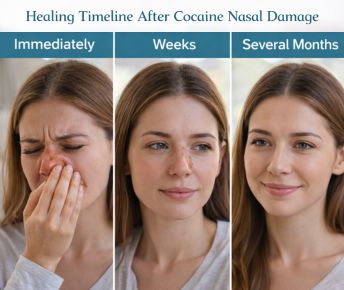
If nasal damage from cocaine was limited to surface inflammation, the mucosal lining can partially regenerate. The nose is designed to repair its lining under normal conditions. Minor ulcers can close. Dryness can improve. Crusting may lessen.
This phase usually unfolds over several weeks, not days. During this time, the tissue is extremely fragile. Any irritation ,smoking, vaping, aggressive rinsing, nose picking, even heavy air pollution ,can undo progress.
This is where people ask, does nasal damage from cocaine heal?
The honest answer here is: some types do.
But this window is narrow. If deeper layers were injured, healing stalls.
When Coke Nose Damage Stops Healing Naturally
Around the one- to two-month mark, most people reach a plateau.
If symptoms continue ,persistent crusting, recurrent bleeding, pain, airflow changes ,it suggests deeper injury. This is usually where cocaine nasal septum damage becomes apparent. At this point, the body has exhausted its ability to compensate.
A septal perforation does not always announce itself loudly. Small perforations may cause subtle airflow turbulence or dryness. Larger ones create whistling sounds, constant crusting, and repeated infections. None of these resolve spontaneously.
Cartilage loss does not regenerate. Time does not fix it.
This is the point where waiting becomes harmful.
Long-Term Structural Damage Caused by Coke Nose
If cocaine use continued long enough to cause cartilage necrosis, structural integrity is compromised. Over months, the septum may weaken further. In severe cases, the nasal bridge can lose support, leading to visible shape changes.
This is not cosmetic damage alone. Structural collapse affects breathing, sinus drainage, sleep quality, and infection risk. Cocaine nasal cavity damage alters function, not just appearance.
Importantly, continued cocaine use after a perforation accelerates deterioration. Healing attempts are repeatedly interrupted, and infection risk increases. Even intermittent relapse can cause rapid progression.
Medical Treatment Options for Coke Nose
An ENT evaluation is not about judgment. It is about mapping damage accurately.
- size and location of perforations
- tissue viability around damaged areas
- infection or inflammatory conditions
- airflow disruption
Management depends on severity. Conservative care focuses on protecting remaining tissue: humidification, topical treatments, infection control. Some perforations are managed with septal buttons to reduce symptoms. Surgical repair is considered selectively and only when cocaine use has stopped for a sustained period.
Surgery does not work in an unstable environment.
Why Addiction Treatment Is Part of Nasal Healing
This is where people underestimate the connection.
Healing the nose requires healing behaviour. Repeated vasoconstriction ,even weeks apart ,undermines recovery. This is why cocaine rehab is not separate from ENT care. It is foundational to it.
Cocaine dependence often involves compulsive redosing, sleep deprivation, poor nutrition, and heightened stress physiology. All of these impair tissue repair. Even perfect nasal care cannot counteract ongoing stimulant exposure.
For people who use crack as well, crack cocaine addiction treatment becomes even more important. Crack use is often associated with binge patterns and systemic stress that further compromise immune function and circulation. While crack does not directly erode nasal tissue the same way, the overall physiological toll delays healing.
This is why crack cocaine rehab and cocaine recovery often improve physical symptoms indirectly by stabilising the body.
Coke Nose Healing vs Cocaine Detection Timelines
People frequently ask about testing during recovery, especially cocaine in urine.
Cocaine metabolites are usually detectable for a few days after use, sometimes longer with repeated exposure. But detection has nothing to do with tissue repair. A negative test does not mean healing has occurred. It simply means the substance has cleared the bloodstream.
Healing is slower. It operates on biological time, not legal or occupational timelines.
What Nasal Healing Looks Like With Coke Nose
Healing does not mean returning to an untouched nose.
- inflammation stabilised
- infections controlled
- no further tissue loss
- breathing functional
- symptoms manageable
For some, this happens with conservative care. For others, it involves medical devices or surgery. For all, it requires sustained abstinence.
Asking can your nose heal from cocaine is understandable. The more useful question is what level of recovery is realistic for my specific damage.
That question deserves an honest medical answer, not internet reassurance.
FAQs on Coke Nose and Nasal Damage Healing
Does nasal damage from cocaine heal?
Superficial mucosal damage can improve. Cartilage loss and septal perforations usually do not heal fully without medical intervention.
How to heal nose after cocaine use?
Complete cessation, ENT assessment, gentle nasal care, avoiding irritation, and addressing cocaine dependence are all necessary.
Can your nose heal from cocaine?
Parts of it can. Structural damage requires medical management rather than time alone.
What is cocaine made of?
Cocaine is derived from coca leaves and processed chemically. Street cocaine often contains adulterants that worsen irritation and tissue injury.
How can Samarpan help with coke nose and nasal healing?
At Samarpan Recovery Centre, we help clients understand that healing after cocaine-related nasal damage is possible, but it follows a gradual and carefully managed timeline that depends on how early intervention begins.
In the initial weeks after stopping cocaine, inflammation and frequent nosebleeds often reduce as blood flow slowly returns to the nasal tissues, provided cocaine use has fully ceased. Over the next few months, mild to moderate irritation, crusting, and infections can improve with proper medical care, nasal hygiene, and overall physical stabilisation.
However, more severe damage such as septal perforation or structural collapse may not fully reverse and may require long-term medical monitoring or surgical consultation. This is why Samarpan focuses on stopping further harm as early as possible. Our program combines medically supervised detox, treatment for cocaine withdrawal, and ongoing health monitoring with intensive therapy to address the addiction itself, which is the only way true healing can begin.
By working on the psychological drivers of cocaine drug use alongside physical recovery, we help clients protect their bodies from additional damage and give their nasal tissues the best possible chance to stabilise and heal over time.