


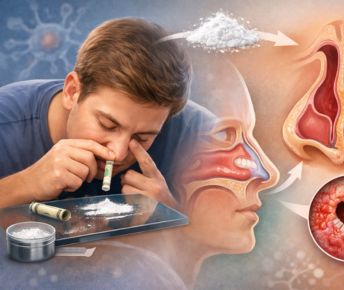



Septal perforation is one of those complications people hear about long before they believe it could happen to them. It’s talked about vaguely, almost mythically, as something that happens to “heavy users” or people who’ve been using forever. In reality, septal perforation doesn’t announce itself with drama. It develops quietly, through repeated injury that feels manageable until it isn’t.
Understanding how cocaine use leads to septal perforation requires understanding how fragile the nasal septum actually is and how stimulant use interferes with the body’s ability to keep tissue alive.
This is not a cosmetic issue. It’s a structural injury with functional consequences, and once it’s there, it changes how the nose works permanently.
What Septal Perforation Actually Is
The nasal septum is the internal wall that separates the two nostrils. It’s made of cartilage in the front and bone further back, both covered by a thin mucosal lining. That lining supplies oxygen and nutrients to the underlying tissue.
A septal perforation occurs when part of that structure breaks down completely, creating a hole between the nostrils. Air no longer flows smoothly. Moisture evaporates faster. Crusting, bleeding, and infection become chronic problems.
Small perforations can be subtle. Larger ones disrupt breathing, voice resonance, and nasal support. In severe cases, the external shape of the nose can change because the septum is no longer providing internal structure.
Why Cocaine Damages the Septum Specifically
Cocaine is uniquely destructive to nasal tissue because of one primary mechanism: sustained vasoconstriction.
Every time cocaine contacts the nasal lining, blood vessels clamp down. That reduces oxygen delivery to tissue that already has limited blood supply, especially cartilage. Unlike skin or muscle, cartilage does not regenerate easily. It survives only as long as surrounding tissue keeps it nourished.
Repeated exposure creates a cycle:
- reduced blood flow
- tissue irritation and ulceration
- delayed healing
- progressive tissue death
Over time, the mucosal lining breaks down. Once the lining is gone, cartilage is exposed. Once cartilage loses oxygen long enough, it dies. That’s when perforation forms.
This process does not require daily use. Frequency matters, but so does intensity, purity, and duration of exposure during each session. That’s why long term effects of cocaine use can appear even in people who don’t identify as “heavy users.”
Early Signs of Septal Perforation
Septal perforation rarely starts with a hole you can feel. It starts with symptoms that are easy to normalise if someone is using cocaine.
Common early symptoms of cocaine use affecting the nose include:
- recurrent nosebleeds
- persistent dryness or burning
- scabbing that keeps returning
- nasal congestion that doesn’t behave like a cold
- pain or numbness inside the nostrils
As damage progresses, more specific signs appear:
- whistling sound when breathing
- airflow feeling uneven between nostrils
- frequent sinus infections
- foul-smelling discharge
- crusting that bleeds when removed
These are signs of cocaine use that reflect physical injury, not just irritation. Once whistling or airflow changes appear, a perforation is often already present.
Why Septal Perforations Don’t Heal on Their Own
This is the part people struggle to accept.
Cartilage does not regenerate once it dies. The body cannot simply “grow back” septal tissue. Small perforations may stabilise, but they do not close spontaneously in most cases.
This is why people asking how to fix septal perforation are often disappointed by online answers promising simple solutions. Healing depends on stopping further damage, not reversing what’s already lost.
Continued cocaine use, even occasional, almost always enlarges an existing perforation. Each exposure restarts vasoconstriction and tissue stress. Healing attempts are interrupted before they can stabilise.
Bony vs Cartilaginous Septal Perforation
People sometimes ask: bony septal perforation occurs in which disease?
Bony perforations are less common and usually associated with systemic conditions like granulomatosis with polyangiitis, severe infections, or trauma. Cocaine primarily affects the cartilaginous portion of the septum, but advanced damage can extend into bony areas over time.
This distinction matters diagnostically. ENTs evaluate perforations carefully to rule out autoimmune or infectious causes, especially if cocaine use is denied or unclear.
Medical Evaluation and Repair Options for Septal Perforation
If someone suspects a perforation, diagnosis is straightforward with proper examination. An ENT can visualise the septum directly and assess size, location, and tissue health.
Management depends on several factors:
- size of the perforation
- ongoing cocaine use or abstinence
- symptom severity
- overall nasal health
Conservative management focuses on symptom control: humidification, saline care, topical treatments, infection prevention. Some people use septal buttons to mechanically close the hole and reduce airflow turbulence.
Surgical repair is selective. Success depends heavily on sustained abstinence. Surgeons will not operate if cocaine use continues, because vasoconstriction dramatically increases failure risk.
This is where septal perforation repair cost UK questions usually arise. Costs vary widely depending on complexity, surgeon expertise, and whether the procedure is private or part of specialist care. Repair is not minor surgery, and outcomes are never guaranteed.
Cocaine Use Disorder and Physical Consequences
Septal perforation is not a separate problem from addiction. It is a consequence of cocaine use disorder, which is characterised by compulsive use despite harm.
Many people continue using even after nasal damage appears, not because they don’t care, but because stimulant addiction alters risk perception and decision-making. The nose becomes something to manage rather than a signal to stop.
This is why addressing why do people use cocaine matters. Use is rarely about pleasure alone. It’s often about energy, confidence, emotional avoidance, or performance. Until those drivers are addressed, physical damage continues.
What Counts as Heavy Cocaine Use
People often ask what is classed as heavy cocaine use because they want reassurance they’re not “there yet.”
Clinically, heavy use isn’t defined only by frequency. It includes:
- repeated dosing within a session
- binges
- loss of control over quantity
- using despite physical harm
- needing cocaine to function socially or emotionally
Septal damage doesn’t wait for someone to meet an arbitrary threshold. It responds to repeated vasoconstriction over time.
Living With a Septal Perforation
Many people live functional lives with stable perforations. The key word is stable. Stability requires:
- no further cocaine exposure
- good nasal care
- monitoring for infection
- realistic expectations
Ignoring a perforation or continuing use usually leads to progression, not adaptation.
FAQs on Septal Perforation due to Cocaine Use
What is septal perforation?
A hole in the nasal septum caused by tissue breakdown, disrupting airflow and nasal function.
How to fix septal perforation?
Options include symptom management, septal buttons, or surgery in selected cases after sustained abstinence.
How to know if you have septal perforation?
Persistent crusting, whistling when breathing, frequent nosebleeds, and uneven airflow are common signs. Diagnosis requires ENT evaluation.
What causes septal perforation?
Cocaine use, trauma, infections, autoimmune diseases, and previous nasal surgery are known causes.
Bony septal perforation occurs in which disease?
It is more commonly associated with systemic autoimmune or infectious conditions rather than cocaine alone.
Why do people use cocaine?
Common reasons include increased energy, confidence, emotional numbing, social performance, and coping with stress.
What is classed as heavy cocaine use?
Patterns involving bingeing, loss of control, continued use despite harm, and reliance on cocaine to function.
How can Samarpan help?
At Samarpan Recovery Centre, we see firsthand how cocaine use can quietly lead to serious nasal damage, including septal perforation, long before people realise what’s happening. Cocaine restricts blood flow to the nasal tissues, and with repeated use, this lack of oxygen causes the septum to weaken, break down, and eventually form a hole that cannot heal on its own if use continues.
Clients often come to us after experiencing chronic nosebleeds, whistling sounds while breathing, infections, or facial discomfort, unaware that these are warning signs of permanent damage. At Samarpan, treatment always starts with stopping further harm through medically supervised detox and comprehensive cocaine addiction treatment, because no physical healing is possible while cocaine use continues.
Alongside medical stabilisation, our clinical team addresses the psychological and emotional drivers behind stimulant use through structured therapies like CBT and DBT, trauma-informed care, and long-term relapse prevention.
While existing septal perforation may require specialist ENT care, our role is to prevent progression, support overall physical recovery, and help clients rebuild their health in a safe, highly monitored environment. By treating both the addiction and its consequences together, Samarpan gives individuals the best chance to stabilise their health and move forward without further irreversible damage.