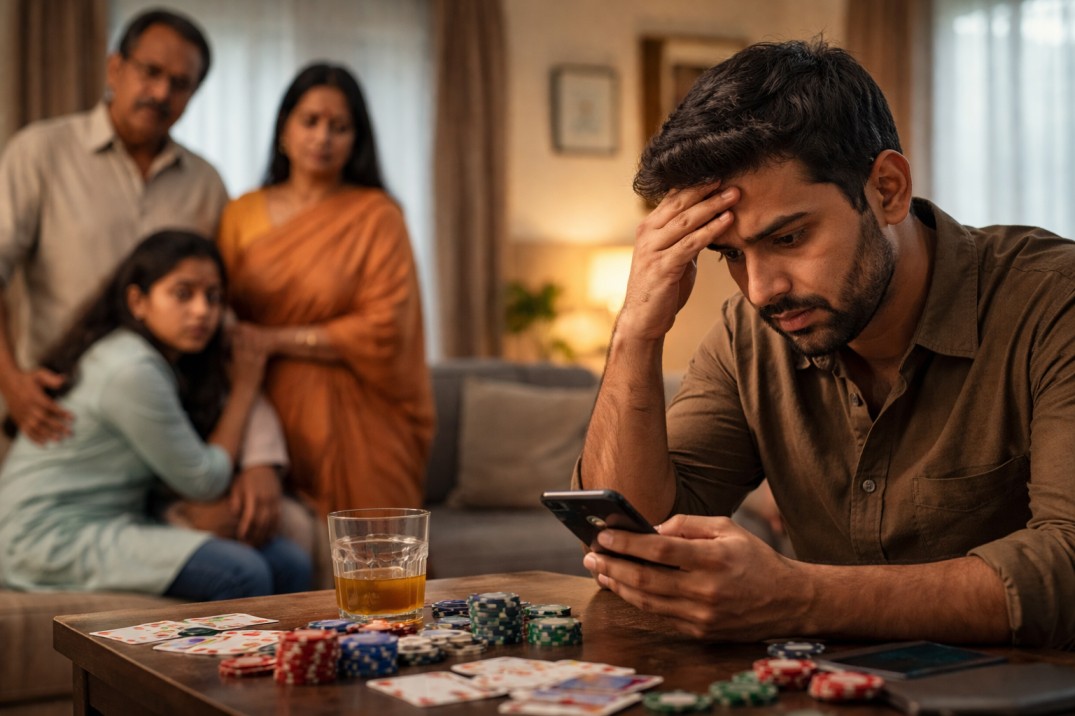






Gambling addiction does not begin with catastrophe. It does not introduce itself with bankruptcy, pawned jewellery, or dramatic midnight confessions. It begins with something far more inconspicuous: rationalization. A few taps on a screen. A modest wager framed as recreation. A fleeting dopamine surge mistaken for harmless amusement.
The mythology surrounding addiction has conditioned us to look for spectacle. We expect visible ruin. Yet online gambling addiction in particular thrives precisely because it masquerades as entertainment. There are no smoky back rooms anymore. There is only a phone, a credit card, and the seduction of probability.
To understand the early architecture of gambling addiction symptoms, one must examine the subtle shifts in cognition, behaviour, and physiology long before the damage becomes fiscally apparent.
Signs of Gambling Addiction: The Cognitive Shift from Chance to Control
One of the earliest signs of gambling addiction is a quiet alteration in thinking. Gambling ceases to be an occasional diversion and begins to occupy disproportionate mental space. Individuals replay outcomes in their minds, calculate hypothetical wins, strategize future bets as though studying for an exam.
There is a peculiar inflation of perceived control. Losses are reframed as “near wins.” Randomness is recast as skill. The gambler begins to believe that persistence, not probability, determines outcome.
This cognitive distortion is subtle but pernicious. It plants the idea that the next attempt will correct the previous loss. And so the cycle commences.
The Normalization Of Small, Frequent Bets
Why do small bets so easily evade scrutiny? Because they appear negligible. Five hundred rupees here. A few dollars there. Micro-transactions dissolve into the digital ether.
Frequent minor bets are especially insidious because they bypass the alarm system of the mind. There is no singular catastrophic expenditure. Instead, there is repetition. Dopamine does not require magnitude; it requires anticipation.
The repetition becomes ritualistic. A bet placed during lunch. Another before bed. The brain begins to associate idle moments with wagering.
Over time, frequency eclipses value. And this is where gambling addiction help becomes essential,long before visible collapse.
How Signs of Gambling Addiction Affect Mood and Sleep
Early gambling addiction symptoms rarely announce themselves as financial distress. They emerge physiologically.
Irritability when unable to place a bet. Restlessness that feels curiously similar to withdrawal. Difficulty concentrating because attention is tethered to an upcoming game or market movement.
Sleep begins to fracture. Late-night betting sessions alter circadian rhythms. Even when not gambling, the mind replays outcomes. The nervous system oscillates between anticipation and disappointment, stimulation and crash.
Over time, this volatility begins to mimic anxiety. Mood becomes contingent upon wins and losses. Stability erodes quietly.
Financial Behaviour That Signals Escalation
Contrary to popular belief, early signs of gambling addiction are not always dramatic debt. They are behavioural evasions.
Unexplained withdrawals. Concealing transaction histories. Moving money between accounts to obscure patterns. Borrowing small amounts under plausible pretexts.
There is often a newfound urgency around liquidity. Cash becomes opportunity rather than security.
When financial transparency begins to diminish, even subtly, it warrants attention. Gambling addiction counselling is not reserved for insolvency; it is most effective before insolvency occurs.
Emotional Loop in Signs of Gambling Addiction
Gambling addiction is rarely about money. It is about modulation.
Stress relief. Escape from monotony. Temporary empowerment. The brain learns that gambling alters emotional states rapidly.
This is the loop: distress leads to gambling, gambling leads to transient relief or intensified frustration, frustration leads to further gambling in pursuit of correction.
Without intervention, this loop crystallizes into dependency.
When Signs of Gambling Addiction Require Professional Help
If gambling occupies disproportionate mental space, affects mood stability, interferes with sleep, or compromises financial transparency, the threshold for seeking help has already been crossed.
Early intervention through structured treatment for gambling addiction dramatically improves outcomes. Cognitive behavioural therapy, financial counselling, and structured accountability frameworks disrupt the cognitive distortions that sustain compulsive betting.
In more advanced cases, gambling addiction rehab provides immersive stabilization, particularly when gambling coexists with depression, anxiety, or substance misuse.
The misconception that one must “hit rock bottom” before pursuing rehab for gambling addiction is not only outdated; it is dangerous. Addiction is progressive. Early containment prevents escalation.
Conclusion
The early stages of gambling de addiction are rarely cinematic. They are incremental. Cognitive distortions disguised as optimism. Financial manoeuvres disguised as management. Stimulation disguised as recreation.
Recognizing the quiet beginnings is not paranoia. It is literacy. And literacy, in matters of addiction, is prevention.
Frequently Asked Questions
-
What subtle habits signal gambling is becoming a problem?
Preoccupation with betting, frequent small wagers, irritability when unable to gamble, and concealing transactions are early indicators.
-
Why do small, frequent bets often go unnoticed at first?
Because they appear financially insignificant individually, even though cumulative repetition sustains psychological reinforcement.
-
How does gambling start to affect mood, sleep, or focus early on?
Anticipation and loss cycles dysregulate the nervous system, leading to irritability, anxiety, sleep disruption, and impaired concentration.
-
What financial behaviours hint at hidden gambling issues?
Secretive account transfers, unexplained withdrawals, borrowing money casually, and defensiveness about spending patterns.
-
When should someone seek help for possible gambling addiction?
As soon as gambling begins to affect emotional stability, financial transparency, or daily functioning,early intervention significantly improves recovery outcomes.
How can Samarpan help?
Gambling addiction rarely begins with catastrophe. It often begins quietly concealed in late-night betting, escalating online transactions, rationalisations about “one last win,” and secrecy around finances. By the time the visible consequences emerge, the behavioural loop is already reinforced. Recognising the early signs of gambling addiction and subtle gambling addiction symptoms is critical to preventing deeper financial, relational, and psychological damage. At Samarpan, we treat gambling addiction as a behavioural dependency with neurological, emotional, and cognitive dimensions. Whether the pattern involves in-person betting or online gambling addiction, our approach begins with comprehensive assessment. Compulsive gambling often overlaps with impulsivity disorders, depression, anxiety, trauma, or underlying reward-system dysregulation all of which are evaluated carefully before designing a personalised plan.Our luxury rehabilitation centre in Mumbai and Mulshi offers structured gambling addiction treatment within a contained, supportive environment. Through specialised gambling addiction counselling, clients learn to identify distorted beliefs about probability, control, and loss-chasing. Cognitive restructuring, emotional regulation training, and relapse prevention strategies are central components of care. For individuals requiring immersive support, Samarpan provides gambling addiction rehab and structured treatment for gambling addiction that addresses both behaviour and underlying psychological vulnerabilities. Family sessions are often integrated, as secrecy and financial strain can erode trust within relationships. Where necessary, we also incorporate psychiatric evaluation to address co-occurring mood or impulse-control disorders. Those searching for gambling addiction help or rehab for gambling addiction often feel shame that prevents early intervention. At Samarpan, treatment is delivered without moral judgment. Structured counselling for gambling addiction focuses on restoring self-control, rebuilding financial responsibility, and strengthening coping mechanisms that replace the adrenaline cycle of betting. Gambling dependency thrives in secrecy and denial. Recovery requires insight, accountability, and structured therapeutic intervention. At Samarpan, gambling de-addiction is not limited to stopping the behaviour it is about rewiring decision-making patterns and restoring psychological stability for sustainable long-term recovery.