


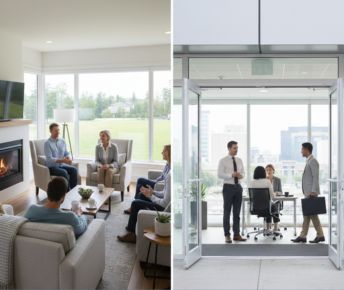



People usually don’t compare residential rehab vs outpatient until they’re already overwhelmed. Something isn’t working anymore , maybe the substance use, maybe the mental health spiral, maybe both , and suddenly there are too many options and not enough clarity.
On paper, the difference looks simple. One is live-in. One isn’t.
In reality, the difference is about how much structure your nervous system actually needs to stabilise.
This isn’t about willpower or severity. It’s about context, capacity, and whether your current environment supports change or quietly sabotages it.
What “Outpatient” Actually Means
Outpatient treatment means you continue living your regular life while attending scheduled therapy or treatment sessions. That could mean once a week, several times a week, or daily for a few hours depending on intensity.
Forms of outpatient care include:
- individual therapy
- group therapy
- medication management
- intensive outpatient programs (IOP)
- partial hospitalisation programs (PHPs)
In outpatient drug rehab or outpatient alcohol rehab, the assumption is that the person has enough stability to return home each day without relapsing, dissociating, or decompensating.
Outpatient care works best when:
- there is a stable home environment
- triggers are manageable
- substance use is not constant
- support systems exist
- the person can self-regulate between sessions
When those conditions aren’t present, outpatient treatment can start to feel like trying to heal in the same place you’re getting hurt.
What Residential Rehab Actually Changes
Residential rehab removes the person from their daily environment entirely. You live onsite. Your day is structured. Access to substances is removed. External stressors are reduced.
This isn’t about control. It’s about containment.
A residential rehab center creates a temporary ecosystem where:
- sleep stabilises
- nervous system load decreases
- decision fatigue disappears
- therapeutic work can actually land
People often underestimate how much energy goes into just holding it together. Residential care removes that burden so the body and mind can finally recalibrate.
Residential Rehab vs Outpatient – Exposure vs Protection
The core difference between residential rehab vs outpatient is exposure.
Outpatient treatment asks you to practice new skills in the same environment that reinforced old ones.
Residential treatment removes the environment entirely.
Neither is inherently better. They serve different nervous system needs.
Outpatient works when:
- stressors are manageable
- relapse risk is moderate
- insight is strong
- support systems are consistent
Residential works when:
- triggers are constant
- emotional regulation is compromised
- self-control is exhausted
- relapse cycles are repeating
Who Is a Good Candidate for Residential Rehab
People often think residential rehab is only for “severe” cases. That’s not accurate.
Someone may benefit from residential rehab programs if:
- attempts to cut down keep failing
- emotional distress is worsening
- substances are used to regulate mood or sleep
- daily functioning feels fragile
- outpatient care hasn’t been enough
This includes individuals seeking residential rehab for depression, trauma-related conditions, or complex substance use patterns.
It’s not about how bad things look , it’s about how sustainable life feels.
What Actually Happens Inside Residential Rehab vs Outpatient
Contrary to stereotypes, most residential programs are structured but not restrictive.
A typical day includes:
- therapy (individual and group)
- psychoeducation
- skill-building
- routine and rest
- reflection and integration
The goal is not to “fix” someone, but to slow things down enough for regulation to return.
This is why residential rehab facilities often produce shifts that outpatient therapy can’t , not because they’re better, but because they reduce noise.
Duration: How Long Does Residential Rehab Last?
There’s no single answer. Programs range from:
- short-term stabilisation (2–4 weeks)
- standard programs (30–60 days)
- extended care (90 days or more)
Length depends on:
- severity of use
- mental health needs
- support outside treatment
- progress during care
Longer stays aren’t about punishment. They’re about giving the nervous system time to rewire.
Why Some People Struggle in Outpatient but Thrive in Residential
Outpatient care requires a level of internal stability that not everyone has yet.
When someone is constantly exposed to:
- triggers
- stress
- access to substances
- unresolved relational dynamics
their brain stays in survival mode. Learning new coping skills in that state is difficult.
Residential care creates a pause. Not an escape , a pause.
How to Choose in Residential Rehab vs Outpatient
This isn’t about which is “better.” It’s about fit.
Ask:
- Can I regulate my emotions without substances right now?
- Do I have a stable home environment?
- Can I tolerate discomfort without immediately numbing it?
- Do I feel safe where I live?
If the answer to several of these is no, residential care may offer the structure needed to reset.
FAQs
-
What is the difference between inpatient rehabilitative unit and outpatient rehabilitative services?
Inpatient (residential) rehab involves living at the facility with 24/7 support. Outpatient rehab allows individuals to live at home and attend scheduled sessions.
-
What does it mean when someone goes to residential?
It means they temporarily live in a treatment facility to receive structured, immersive support away from daily stressors.
-
Who is a good candidate for residential rehab?
Anyone who struggles to stabilise in their usual environment or has not benefited from outpatient care.
-
How long do residential rehab programs typically last?
Programs usually range from a few weeks to several months, depending on needs and progress.
How can Samarpan help?
At Samarpan Recovery Centre, understanding the difference between residential rehab and outpatient treatment is essential in choosing the right level of care for long-term healing. Residential rehab offers a highly structured, immersive environment where individuals step away from daily triggers and receive 24/7 clinical support, making it ideal for those experiencing severe drug addiction, intense substance withdrawal symptoms, or repeated relapses. This level of care allows for close medical monitoring, emotional stabilisation, and consistent drug addiction therapy, especially during early recovery or alcohol withdrawal, when safety and structure are critical. Outpatient treatment, on the other hand, is better suited for individuals with strong external support systems and milder symptoms, allowing them to attend therapy while maintaining daily responsibilities. At Samarpan, we carefully assess each individual to determine whether a residential setting or outpatient approach will best support recovery, always prioritising long-term stability over short-term fixes. As a leading drug recovery center, we integrate personalised treatment plans, trauma-informed care, and structured de-addiction therapy to ensure that each person receives the level of support their recovery truly requires, whether that means full-time residential care or a stepped-down outpatient path.